WHAT IS AUTHENTICITY? Let’s unpack

Authenticity is a concept in psychology, existential psychiatry, existentialist philosophy and aesthetics. In existentialism, authenticity is the degree to which a person’s actions are congruent with their beliefs and desires, despite external pressures to conformity. 

Wikipedia

This is an interesting topic to discuss and share personal opinions and beliefs. So excited to hear your thoughts of this Lily.

Yes, HJ. This is an interesting topic indeed. So, what is “authenticity”??
Let’s see what we unpack in this topic.

Be fearlessly authentic.

Bravely be you.

I so love this quote. For me it’s the being “brave enough”. Living authentically can at times, in my expereincce be a “lonely” place to live.

For me, following quote explains how I perceive authenticity.

Authenticity requires vulnerability, transparency, and integrity.

Janet Louise Stephenson

I grow up in a culture expressing your vulnerability was greatly discouraged. Yes, I thought it was a bad thing to show others your “weakness”. I used to complain “I don’t think anyone really understanding me [including my weakness/vulnerability].” Now I know why because it wasn’t something I tend to show others. Some may say I am a private person. Other may say I am a naive person. I say I didn’t know how to express my vulnerability to others.

Only years later, when I gathered my courage and started showing my vulnerability to others, I realised that it actually wasn’t my weakness. Showing my vulnerability to others was actually become a strength in life. By showing my vulnerability I allowed myself to accept help from others. Because of accepting help from others, I can grow and advance further than I have ever imagined.

Many times I’ve felt so much the “black sheep” yet knew, again from past experience, trying to fit in where I don’t belong takes too much energy and is a struggle who I truly am.

Growing up it was all about fitting in, don’t stand out, be what you are “supposed to be”, “don’t rock the boat”. None of this sat well with me and I truly struggled to fit where I was supposed to.

I am hearing you HJ.
Experiencing different culture during my childhood and early adulthood, I tried very hard to “fit in” to the culture I was in at that given moment. The harder I tried, the further I stood out. I was just so different. I was confused. I was receiving contradictory guidance of “what I suppose to be” and eventually I have lost myself.

This concept of “lost of myself” was so strong in the majority part of my life until now. If you remember HJ, when we first me few years ago, I was a person “lost of who I am”. Very interesting to make this comment to others and majority of people answered “You are Lily.”

Yes, I know. That’s my name but who is ‘Lily’. What does she like to do? act? behave? or what does she present herself? To some extent, I hated the fact I don’t have the answer to these questions. I was lost. I didn’t know where I was heading, where I am going, what were my values in life. I really wanted someone to give me an instruction book or guidebook and say “This is who you are. This is what you were born to achieve in this lifetime. These are your life lessons planned for you. This is your life”. Well, no such miracle happened so far.

Growing up when I did (born 1955) choices for women was limited. Back in those day women could not work when pregnant and in a few industries, you could not work if you married. I remember too, which today sounds ridiculous, women could not wear trousers in the workforce. The list just goes on and on. It’s no wonder so many women born in the 50’s ad 60’s still struggle to get in touch with, let alone live authentically.

I know some of the culture still live in those values.
So, what does “living authentically meant to you?”

What is Authenticity? What Does it Mean to Be Authentic on the Internet?
How to Develop Authenticity
Here are some tips to help you find and express your authentic self.
1. Observe yourself objectively to develop authenticity. Learn to observe yourself like a fly on the wall. Watch yourself as you live in the present moment, observing how your “Adaptive Self” behaves, what it believes, how it reacts under pressure, and how it responds to challenges. Practice noticing which of these responses feel authentic, and which ones feel inauthentic. By identifying which responses are adaptive vs authentic, you can begin to notice the falseness and begin to see the glimmers of truth underneath.

2. Examine family belief systems to develop authenticity. Most people were raised in some sort of “family-style” environment during their earliest, most vulnerable years. Think back to episodes in your childhood, episodes that led you to stop being your authentic self and instead adopt some other way of existing in this world. By examining where our behaviors come from, we can learn a lot about our authentic selves.

3. Open a dialogue between the Adaptive Self and the Authentic Self. Invite the two aspects of yourself—the Adaptive Self and the Authentic Self—to have a discussion as part of a meditation or thought exercise. Respectfully introduce both: Thank the Adaptive Self for helping you function through some difficult and confusing times, and thank the Authentic Self for helping you feel whole, real, and self-confident.

Now invite each part of yourself to share. Ask a question, mentally, while urging each side to express itself fully, and then listen patiently to the responses. Encourage dialogue so that you may comprehend both points of view.
Try to be open to what both sides have to say, as they may reveal things you’re not expecting. For example, the Authentic Self may be afraid of rejection and therefore afraid to come forward. Or your Adaptive Self may be caretaking, trying to protect you from feeling hurt in the ways you’ve been hurt in the past. These parts of ourselves are running our lives this way for a reason. In this exercise, try to figure out what those reasons are. This may help you understand why you act the way you do, so you can decide if you truly want to act differently.

I decided to reference the above from Positive Psychology. It’s my go to when wanting more information and the psychological perspective. I included it here as I felt I didn’t need to “reinvent the wheel”.

I am a good fun of positive psychology too.
Yes, I must admit, I had many conversation with myself, adaptive self and authentic self. I acknowledge the existence of both within me. I really appreciate the protection of adaptive self in my life. I thanks to my authentic self checking-in every now and then, making sure I am moving in the direction my heart sing. I now allowed my authentic self to take the driver’s seat and my adaptive self to check-in every now and then for the safety. I love my life.

A privilege of a lifetime is to become who you truly are.

Carl Jung

Now I need to understanding how our “Adaptive Self” fits in all this. The following is from Mindful Muses an article by By Laura K. Schenck, Ph.D., LPC

The difference between utilizing the false self in an adaptive way versus a maladaptive way has to do with both our awareness of its attributes and sense of congruence between our social masks and our core values.

When we are aware of the many sides of ourselves we are able to gain a sense of ownership and mastery over when and how we choose to show these sides.  When we are in control of what part of ourselves we choose to show, the false self is no longer foreign and detached: our social masks become congruent and integrated.  We are whole.

Laura K. Schenck, Ph.D., LPC


For many years in my life, this is what I have struggled for. One day, I realised that I wear a mask in a certain situation and another one in another. I felt both were “me” indeed while both were NOT true “me”. I struggled between those masks that I have created along the way to protect myself.

One day, a person told me that “It is okay to choose what to share with whom you want to share your life with.” It shed the light on my confusion of having multiple masks. Until then, I thought I need to share my “whole” life with others who were in my inner circle of friendship yet I also knew it is impossible for a person to know my inside-out. I felt upset when they didn’t react in the way I “expected” them to. Similarly, I was so scared of people’s judgement call on my reaction too.

I now understand it is their problem how they want to react to my comment. I am responsible for my own act and behaviour. When I reflect at the end of the day, I would pose a question to myself “if I have second chance or in the same situation again, would I do it differently? would I say it differently?” Majority of the time, I wouldn’t because I have given my best shot at that given point of time.

Authenticity is the daily practice of letting go of who we think we’re supposed to be and embracing who we are.

Brene Brown

I’m still having my moments. I am at a stage in life where I am aligned with my authentic self that I can show up as me. I know not everyone will “agree” with how I live my life, my opinions, my beliefs and values and that’s ok. I am continually growing, changing, learning, developing and reassessing, reevaluating and changing with each day, each connection, and embracing it all as a great ride.

Yes, I am proud lifelong learner too.
Let me share a quote with you. This is a quote posing a question I ask myself often when I self-doubt my progress in life.

Before comparing yourself with others, win the battle with yourself. Strive to be better today than yesterday and better tomorrow than today.

Daisaku Ikeda

Who’s picking me up?

Migrating to different countries, I never really thought about this until one day when I start picking up my niece from school. I guess, there’s many other factors that influence this practice. So, let me try to explain this notion of “Who’s picking me up today?”

HJ, do you remember how you travelled to and from school?

Interesting topic Lily. Yes I do remember how I travelled to and from school. In my primary years 1 – 7 I lived across the road from the school so I just took my self to and from. Many times coming home for lunch. My mother would ask if I had permission and I always said yes! I still don’t know if anyone at the school knew I did that.

High school Year 8 – 10 I either rode my push bike (it was a long way away and there were no school buses) or got a ride with friends parents.

Let me share how this notion emerged. I do think this may be a cultural practices.
I am dropping-off and picking up my niece from her primary school everyday. However, one day I realised that wasn’t what I used to do when I was at her age.

Yes I hear what you are saying. When my daughter went to school I dropped her off and picked her up or I would take in turns with parents whose children were in her class and lived close by. We would sometimes walk to school and home. It was something I didn’t let her do as it was not safe for many reasons. Too far, wandering dogs and unfortunately those people who targeted children.

High school for my daughter was the school bus there and back as it was quite a distance. The only time I picked her up was if we had something to do after school. She enjoyed the extra time with her friends and I was working full time so it was a wonderful option.

When I was attending primary schooling in Japan, I used to walk to the school by myself or in a group of friends. I remember a friend had to walk 30 minutes from home whilst I was about 5 minutes. Yes, the situation changes if I was attending private school yet majority children of primary school age would walk to the school. Even with children attending private schooling, they may travel to and from school themselves using public transport.

Children don’t seem to walk these days whether to school or not. I feel it might be due to their parents not wanting to walk with them. It’s so much about our children not being safe to be out of their own these days. Many children get dropped off in before and after school care and parents drop off and pick up due to their work commitments. There were the children called “latch key kids” who went home to an empty house. My daughter would get off the school bus at my work place and then walk about half a kilometer to our home. Luckily I had wonderful neighbours who would keep an eye out for her and she rang me when she got home. She didn’t go home to an empty house during her primary school days Year 1-7. I was working at another school and would have her dropped of to me or go home with a neighbour till I could pick her up.

What happened to the tradition of walking to school? The simple... |  Picture Quotes

Yes, these days in Australia, children may attend schools that are out of their catchment area. This means that they can attend school at the other side of the town if they are accepted. This has contributed to the increased physical distance between home and the school.

Are children able to attend school outside their catchment area? This was not something I experienced myself or with my daughter. Back in my day (don’t you hate that statement) it was about attending the school which offered the subjects you were wanting to follow through with to set you on your career path.

I remember my auntie who had lived in Taiwan, used to pick-up my cousin from her primary school. My auntie used to send a lunch to my cousin around the lunch time too. She explained it is a safety reason as well as practical reasons.

Oh yes, that makes so much sense. It was always a worry going to school with food that would not go off not being refrigerated. These days most classrooms have a fridge for the children’s food. I put the freezer blocks in my daughters lunch and for me, well my lunch was always a vegemite sandwich, homemade cake or biscuit and water. I often went home for lunch so there was no worry.

Safety of the school zone is another aspect of this issue. In Japan, we used to have mandatory school name badges. Yes, this is now an eliminated practice because of privacy issues. Let me share a news with you about my primary school.

Yes I think we had names tags when I went to school. My daughter did too. Yes, there is the safety concern these days. Children being lured by others who could see their name and use it to try to make the child feel safe when they weren’t. It so sad that we need to take these precautions these days. It can limit the children ability to develop resilience, problem solve and more. This was called Protective Behaviours back in the 80’s and something we taught in Primary School.

I have attended a primary school for 5 years (a year in the other school). This was in Japan. Never had an issue with safety, walking from and to home. Years after my graduation, I heard a girl was kidnapped after school, on the way home. I was so devastated for the safety around the area. This has enhanced many school to emphasise children to travel as a group.

Safety and security don’t just happen, they are the result of collective consensus and public investment. We owe our children, the most vulnerable citizens in our society, a life free of violence and fear.

Nelson Mandela

Such an important quote you’ve shared Lily. It is the responsibility of everyone to keep our children safe. Yes there were those things going on when I was at school and also when my daughter was at school. Educating our children about not going with anyone they don’t know regardless of what they say; to have a password so that if someone else is picking them up they need to know it and so many other strategies. I think most school are so conscious of the issues surrounding custody of children that they have plans in place. It would be one of the first things I would check with the school my child was attending.

Many children are attending after school curriculums. This may be one of the reason why children need a pick-up. In my auntie’s case, my cousin was attending after school curriculum every night, many teacher made it mandatory, so my counsin had a small potion of time to eat, and get ready for the next activity. I remember some of my counsin came home after 9pm.

Yes, it’s a safer alternative to the children going home alone. I often cared for foster children who were in after school care and I had to be approved and checked and sign in to pick up the children. I was so impressed at this process to keep our children safe.

What’s your experience like for after school curriculums HJ?

That was not available for me. Back in the days I went to school there was always someone home. During my daughters days, there was no after school care. She either got dropped off to me or went home with friends. It wasn’t until Year 8 – 10 that she came home on the school bus to my place of business, checked in with me and then the short walk home (watched by very safe and reliable older neighbours) and then rang me when she was locked inside. She was usually only on her own for an hour. She knew the rules. No going outside or answering the door.

Home Alone Rules - iMom | Kids and parenting, Parenting, Parenting help

Moving to Australia, I experienced school bus and public transport. Well, both method provided different experience. It was an effort to walk a very long uphill in hot summer afternoon.

Yes the introduction of school buses certainly made it easier and safer for our children to get to and from school. Although I think there are still schools what don’t have that. For me it’s all about what is the safest option for our children.

Who’s picking me up today?

Great question Lily. That would be me picking me up.

YOU ARE A VERB

We are not nouns, we are verbs. I am not a thing – an actor, a writer. I am a person who does things, write, act, and never know what I am going to do next. I think you can be imprisoned if you think of yourself as a noun.

Stephen Fry

This is a very interesting quote HJ.

This is such a huge belief for me.

There are no labels for who I am. I am action, I am always learning, growing, sharing, challenging, serving. I’ve always seen myself as a human BEing first DOing extraordinary everyday things.

I resonate with above quote too.
It is indeed. I am a verb.
Even though I believed that I am a human being, it was quite hard to believe in that when I was lost in my identity.
I needed to see myself as a noun first before I can start seeing myself as a verb.
I can now appreciate, “I” am the person who do all those things I enjoy in life. In other words, I am in control of my life that I live now.

After that, well I guess others need to label me, female, woman, daughter, sister, wife, mother, speakers, teacher, netballer, mentor etc.

Yes. This list I belive this list can go on and on.
Sometime it is about the situation, other times it is about your role and social position. It is a convenience for others, I guess.

A genuinely happy person is one who has rendered others happy.

Daisaku Ikeda

I had a very interesting conversation with my sister-in-law one day. I admire her ability to juggle everything in the family which I am yet to have a taste. I was amaze by her ability to be so thoughtful about every member in the family. So I simply expressed that to her.

Me: I admire those who have married and able to care for others like you do. I guess, because I am yet to master that I am yet to be married.
Sister-in-law: No. It is not about whether you are married. It is regardless of whether you are single or married or whatever other status in life, you are happy.

I was stunned for a bit and knew she’s right. Yes, it is not about my status, in other word noun. It is whether I am happy where I am, in other word verb.

ok, let’s see what else I’ve been.

singer, piano player, painter, builder, landscaper, potter, gardener, writer, oh this is fun, trainer, embroiderer, knitter, seamstress, renovator, collector, reader, artist, jeweller, chocolatier, taxation consultant, bookkeeper, executive assistance, bursar, bar improver (loved that label), bar maid, cleaner, home carer, coordinator of crisis services, administrator of bequest funds, client services officer, education officer, project officer, special education support worker, behaviour modification trainer, netball coach, hostess, event coordinator, wedding coordinator, mediator, advocate, freedom fighter.

I am always fascinated by your background. I can gurantee you are a unique human being in this world.

All these things and more are things I’ve done not who I am.

I remember I had a dialogue with a friend saying that “I am more complex then those nouns can describe. I am who I am yet it is indescribeable who I am.”

Everything begins with the resolve to take the first step. From that action, wisdom arises and change begins. Without action, nothing changes.

Daisaku Ikeda

Oh yes, I am a VERB and my life is a VERB.

Yes.Yes.Yes! | Best quotes, Great quotes, Greatful

I learned that change only happens when ordinary people get involved, engaged, and come together to demand it.

Barack Obama

I DON’T FIT IN

I do know it’s not just a cultural “thing”.

HJ, I don’t think it is just a cultural “thing”. I think it might be beyond just a cultural “thing”.

There has been so many times I’ve felt this way here in my home country Australia and when overseas.

Is it a cultural “thing” or an emotional/feeling “thing”.

A very good question. I battled with this feeling of “don’t fit in” for the most time of my life. Well, moving from a country to another, it was difficult to secure my identity. Only recently I realised not only people like me, who moved from a country to another, will have such feeling of “don’t fit in”. I realised people who never left the country they’ve born may also feel that.

It can be difficult to fit in even when you speak the language, understand the culture and know “what’s expected” yet add to that not being able to speak the language, understand the culture and not know what’s expected and all this can keep you “locked away” not wanting to find others who feel the same way.

Well, I guess, it is not just speak the language, understand the culture, and know “what’s expected”. For me, it was finding the balance between been unique while you are similar to others. For me, it was about belongingness. Where do I belong? Where can I belong? Who do I belong? Not able to find an answer to these questions lead me to a quest: Who am I?

I have experienced a culture which embraced the notion of been ordinary. When you are different, you have been tagged as an “odd” person. I didn’t like to be an “odd” person so I tried everything I can to fit in. Yet, no matter what I do, no matter how hard I tried, I was still an “odd” person who was different to the majority of the people around me at the time. At the same time, I was starting to accepting my history of being an immigrant, yet I still wanted to be accepted to that culture. Well, yes, I was trying to solve unsolvable question.

As my background of living in different countries was a unique experience, I saw it as a flaw rather than a uniqueness. It took me a long time to start embracing it as my uniqueness. It wasn’t a present experience when you are battling with constant rejection, exclusion and elimination.

I didn’t like group works because I didn’t know how to contribute. I didn’t like people asking me questions because I don’t have an answer for them. I didn’t like parties because majority of time I don’t know what they are talking about. It might due to lack of language proficiency yet it was more than that. It was that feeling of insecurity of not belonging to anywhere.

We all have ability.

The difference is how we use it.

Stevie Wonder

This brings me to expanding our language around those emotions and feelings to understand more about what’s going on. English speaking people still don’t have an expansive language around emotions and feelings so I can only image how difficult it would be for those who feel their English is “not good” let alone trying to understand the meanings of the words.

Yes, HJ. That’s what I meant. So what is it? I had so much trouble understand what do they, I mean each word, really mean.

I thought I would include a list and see how many you are confident with using.

This is a very interesting figure. I can recognise some words that I use often and others that I never heard before. Well, at the same time, some words I have different meaning attached to it.

The isolation can bring with it so many other issues.

Yes. Isolation can be very lonely. I used to live in a large city away from my family. Population density of that city was higher than where my family were. I still felt lonely and isolated. That was the first time I felt I was lost in the big city. I don’t know who to turn to. I don’t know where to go to. I was happy in my own little shell yet hoped someone to get me out of the hole.

And then there are our children. Trying to fit in, learn the language and all the different terms for things.

Yes. I went through that. It was a long battle finding myself.

Just as cherry, plum, peach and damson blossoms all possess their own unique qualities, each person is unique. We cannot become someone else. The important thing is that we live true to ourselves and cause the great flower of our lives to blossom.

Daisaku Ikeda

I have taught migrants English and basic maths for over thirty years and have discovered people from other countries are so intelligent and have a wicked sense of humour and great stength when you give them a chance.

I saw my parents do that. I mean when they decided to migrate to Australia, they were willing to do anything to make this move work. They tried everything they can. Grabbed any job they were offered. Eventually, they slowly found their way.

Discussing the “difficulties” and “no particular rules” to learning English has been a joy for me and so much fun for the “migrants”. Many became family for each other and many welcomed me into their family and culture. When learning is fun, it changes everything. There is no longer the expectation of trying to be “perfect”.

Having travelled extensively, I do understand how isolating it can be and I’ve also experienced the love and generosity of so many. This has always been something I’ve wanted to do here in Australia, regardless of where a person was born of the culture they were born into.

I think you have successfully done so. I think you have told me how to kindly ask when I don’t know. It was an eye opening experience discovering I enforced so much boundaries and expectations on myself that others didn’t really care. It took me a lot of courage, reframing and questioning of what each word mean to that person who have used it.

Building a persons ability to communicate, and even more so their self esteem to not give up and remember in many cases it’s not about them, it’s about the inability of others to understand.

One huge lesson I’ve learnt is that if you are feeling you “don’t fit in” then you probably don’t. Harsh maybe, yet why waste your valuable time and energy where it’s not being appreciated or valued.

What I have learned from my experience?
I have learned to belong to me, myself. Regardless of external groups that I may belong or not to, I belong to myself. After discovering where I belong to, I am firmly grounded on who I am which allowed me to discover beyond my comfortable zone. Only then I felt, it is okay I may not belong or fit in. It is just a spice in life.

People who are rooted in the here and now, who are not defeated by their limitations, who don’t compare themselves to others, who confidently advance along their chosen path – such people are happy, such people are truly great.

Daisaku Ikeda

My experience has shown me that when you do this, you miss opportunities to connect with “like minded” souls. It can be a lonely time while you are “out there” looking for “like minded” souls yet, it’s for the long term and you meet so many different people and learn more about who are “your people”. They are there.

Until you find them, keep believing you have so much to contribute to this world and even if you are “struggling” to fit in, remember you already do. BE you and they will come.

If it doesn't open, it's not your door!” (3.25.19) | Life path quotes,  Daughter love quotes, Wisdom quotes

GENDER ROLES – Woman’s V Man’s

from goodlifegoodchoices.org

“Man up!”

That’s not very ladylike.”                     

You throw like a girl!”

The vast majority of us have heard and said statements like these many times – statements that direct or judge actions based on gender. Our ideas about how men and women are supposed to act, their strengths and weaknesses and the types of choices they should make can greatly impact our self-concept, or how we see ourselves. Self-concept is a key factor in the choices we make, since it determines what we see as right, and even as possible, for ourselves. When ideas about our gender unconsciously influence our self-concept, we run the risk of guiding our lives by assumptions that, when exposed to the light of conscious thought, might turn out to be wrong. This is why it’s important to think critically about gender ideas and how they influence our decision-making.

While thinking about this article I remembered being brought up to believe a good wife and mother keeps a good home. Does all the house work, and looks after the man.

My mother was one role model. She kept a strict home and the men were to be looked after. That was my Father and my three brothers. My role was to learn to cook, clean, sew, iron (everything), and learn how to keep the men happy. They were allowed to enjoy themselves while I had to learn to do all these things “properly”.

What was it like for you Lily, growing up as a woman? Were you expected to learn how to be a good wife and mother and what that meant?

What an interesting topic HJ. My mum might hold such thought “being a good wife and mother to keep a good home”, yet moving to different places made it difficult to hold on to it. I guess, my mother was raised in an unique family where girls were also encouraged to obtain higher education. I know how she struggled to fit into “home” so she did not enforce that to us. (Recently, she said she regret not teaching myself and my sister about housework though)

In the culture I grew up, yes, there is a certain societal expectation that you get married by certain age, start your own family, raise the children, look after your family. That is the destiny to be born as a woman leading to the happiness of woman. My mum certainly hold such believe yet she is quite accpeting of ‘new’ ways of life that women can now ‘choose’.

I think this goes back to my maternal grandmother. She has raised seven children, majority to become healthcare professionals, except my mother who has chosen engineering. My maternal grandmother had been recorgnised for her mothering and have been awarded for her effort.

Successful mothers are not the one who have never struggled. They are the ones who never give up, despite the struggles.

Sharon Jaynes

My mother was the second youngest and the youngest girl in the family. So, she hardly had to engage with housework. When she got married to my father, she struggled because she married to the eldest son, meaning that she had to help my paternal grandmother to run and manage the house with three younger sister-in-laws and brother-in-law to take care of. They were still in their schooling. Not only that, she had difficult time adapting to the new way of being a woman in the family.

None of this sat well with me and yet I was not given any other alternatives. It was the ultimate for any girl/woman, to keep and good home and raise a family and be a good wife. I never really knew what that all meant. It didn’t sit well with me. Give up my life for everyone else and what ever I wanted to be, do, was not as important as what the men wanted.

I believe that was what my mother experienced too. She hated cooking (she told me later in life), she hated cleaning in the [ancient] way (as she called then) my paternal grandmother told her to. Even during her pregnancy, she had been asked to wipe the three-starry house kneel down, wipe cloth on the hand, including all the steps. She said that was torture days in her life.

When I married for the first time (yes, I’ve been married twice and divorced twice and that’s another story for another time) I tried my best to cook, clean, keep a home, allow my husband to do what he wanted and look my best at all times I was with him. I gave up my life for him, and he loved it. So much so, he saw other women, was always out with his buddies and did very little around the home. Even when our daughter was born, he didn’t give up his life. It wasn’t until he met another women and she became pregnant that our marriage ended.

In the 70’s women could not continue to work if they married in some industries and definitely could not continue to work when pregnant.

I heard about such stories still exist in many modern Asian countries around the world. I wonder why in some countries their birth rate continuous to fall because the society is not supporting women back into their workforce. I can see some sort of improvement over time though.

My second marriage (eight years later) was very different. I was not going to be the one that did all the “woman’s” work and it was about sharing. He could cook, clean just a well as I could and I could work in the garden, build, renovate, paint etc just as well as he could. We had a relationship where there were no male or female roles.

A Relationship With No Gender Roles love love quotes quotes quote  relationship quotes love images rel… | Relationship goals quotes,  Relationship quotes, Goal quotes

I don’t understand why it’s taken for granted still today that women work in the home and men outside. Even with women working outside the home, in many cases they are still expected to care for children, wash, clean, cook etc.

Isn’t that fascinating? I wonder whether it was a lead-role for woman or we have been groomed in such a way we have become better in performing those roles. Having said that, at a stage of my life, I really believed in that gender-based family roles.

How are we raising our children? Why would we not teach them to be able to look after themselves, a home, another person without the old fashion gender roles.

It is fascinating what we potray to children about this gender-roles without any intention that you are potraying gender-roles to them.

One day, I was talking to my niece about something. She said “Well, I am a girl so I should do x, y, and z.” I was shocked and looked at her and said “not really. You have a choice not to do x, y, and z.” She thought about it for a while and rephrased “I want to do x, y, and z.”

This was an example of when I realised, as an adult, how much influence I have on children. Well, yes, I know watch very carefully of my thoughts and comments by questionning where did I get such perspectives from. Is it real? Is it true? Is it just my imagination? or is it just my perspective?

Gender Stereotypes in the Media | The Pedagogy Princess

It’s not about who is at home all the time. Who is raising the children. Who is responsible for household duties.

Why can not all this be shared and worked out between the people involved?

SKIN COLOUR

I was reminded today by a friend how she worries about her skin being too dark.

She wants fairer skin. In her culture fair skin is considered to be so special and much sort after by suiters. So much so that she covers her skin completely when going outside. She also uses shin lightening creams hoping for her beautiful skin to be lighter.

Is the colour of your skin an issue for you Lily in your culture?
And if it is who do you deal with that?

That is a very interesting concept HJ.
|Yes, in the culture I grow up, they prefereed fairer skin. As a child, I always had a fair skin. Well, it was harder for me to ‘bake’ myself, I believed. However, as I get older, I have proved this is not true. It was the matter of the time.

When I return to my ‘mother country’ as a child, I saw my aunties cover themselves up, wearing everything they possibly can to protect themselves from sunburn. I always found amazed on how they keep wearing it in such humid and hot weather.

This perception has changed when I started driving the car.
After learned how to drive a car, I started to wear long sleeves to cover my arms and blanket to cover my feet. It is to protect myself from sun, not really sunburn though. I realised that cover myself up in thin layer of cloths are much cooler than when I do not wear them.

Me on the other hand while growing, up wanting tanned skin. It was considered healthy. In my youth tanned skin made you look better. Whatever than meant. Tanned and blonde was considered “sexy” and a look we all wanted to achieve.

I was always lying in the sun on the beach. My life was outside and I so enjoyed getting a “touch of the sun” and the browner the better.

I had a friend who shared her skin story with me once. She was from similar culture of mine, fairer skin is better than darker skin.
In comparison to the other general public, she naturally had tanned/darker skin. Her sisters had fairer skin and she hated her tanned skin until she met her husband-to-be.
Her husband-to-be (now husband) is from Spain. According to her, Spanish people, like you HJ, prefer to have tanned skin. So, him and his family was fond of her skin. Only then, she started to accept her skin colour and who she is.

The color of a person’s skin had nothing to do with the content of their character.

Michael Jackson

It didn’t take me long to realise that people who had darker skin were considered less than the “white ones” and yet there were us, the white ones, trying to get dark skin.

That’s a different connotation. Isn’t it interesting how far we thought we have come along yet how far we thought we are behind of where we need to be.

Quotes About Skin. QuotesGram | Skins quotes, Skin care solutions, Good skin

I can remember a conversation I had with a friend of my older brothers who had dark skin and his surname was White. I think I was only around 6 or 7 years of age and I asked him why his name way White when his skin was dark? The innocence of children. He was so kind to me and told me his surname had nothing to do with his skin tone. That was enough for me. I moved on.

Yes innocence of children. Well, he was wise enough to answer you with what you need to hear at the time.

There should be no discrimination against languages people speak, skin color or religion.

Malala Yousafzai

Even with all the warnings that staying in the sun too long and getting sunburnt, is damaging out skin each time, and yet we still do it.

Now, my skin is sun damaged and I rarely expose my skin to the sun. I’m the older version of my Asian friends who want fair skin. I must admit I do prefer tanned skin, yet without the damage and skin cancers.

And then there are the people who have very fair skin and burn so easily and quickly and keep away from direct sun. I guess that’s why sun tanning salons are doing a booming business.

Okay, let’s take a moment and let me come from the scientist point of view.
Under the sun too long will be bad for you. Particularly for those who are living in places where ozone layer of the earth are damaged. Yes. Depending on your skin colour as well though, too much sun will increase your risk of skin cancer.

On the other hand, when you expose to sunlinght, your skin makes vitamin D from cholestrol. Vitamin D has many roles in the body such as it helps calcium and phosphate intake which are two minerals essential for maintaining strong and healthy bones. Low level of vitamin D can risk your health and wellbeing such as osteoporosis, cancer, and depression. Please note: There are other ways to take vitamin D such as food and supplements.

Funny how we are not satisfied with the way we are born. We always want to change something.

Isn’t that a proof we are human?

Skin colour seems to be an issue in all cultures. We either want to be darker while being prejudice against those who are naturally dark skinned. Or there are those who have “tanned” skin by birth and want to have lighter skin.

What was that old saying in English?
“The grass is always greener on the other side of the fence.”
We often compare ourselves to others, envy or become jealouse of them. Yet, we are the unique being in this world.

Envy is the art of counting the other fellow’s blessings instead of your own.

Harold Coffin

This phenomenon of colorism — exalting lighter skin and assigning it higher value, thereby reinforcing racial power imbalances — isn’t limited to South Asia, of course. A study on colorism among Black Americans found that darker skin correlated with “lower socioeconomic status, more punitive relationships with the criminal justice system, diminished prestige, and less likelihood of holding elective office.” And as is the case in America, skin color often helps determine social hierarchies and acceptance in the subcontinent. nbcnews.com

I was raised in a home that was filled from people and children from all walks of life and colours and abilities. I never saw anyone as different. We were just people, children, and had fun and enjoyed each others company.

The Importance of Skin “Color” | Gandalf Stormcrow

I still struggle to understand the prejudice other have against people of different “colours”. It almost as if that don’t have the same feelings, struggles, as the rest of us. It’s so too often them and us.

Let me elaborate on that.
For me, it was about fear of entering unknown. It was lack of courage to expose myself to the outside world. It was fear of being judged, exluded, incarcerated, and isolated.

In one of my early days in Australia, I was discussing similar matter with my English tutor. He said “Look, not only you who have migrated to Australia feels that. I as a mainstream, caucasian Australian, I feel fear towards newcomers too! But, I overcome such fear by approached them, talk to them. When I turned unknown into known, newcomers become my friends.”
I remember this dialogue so vividly because he was the first person taught me that: 1) not only me as a migrant feel the fear; and 2) there is a way to ovvercome such fear.

As you have said HJ, eventhough we come from all sorts of background. Yet, we are human.

Wouldn’t it be wonderful if it we could all see each other for the amazing individual with so many unique gifts? We all need each other to be just that and make up the beautiful jig saw puzzle of the world as one.

There should be no discrimination against languages people speak, skin color,  or religion. - GIF QUOTES

Treasuring each individual.
Respecting everyone.
This fundamental spirit of respect in the hear of Bodhisattva Never Disparaging’s practice [of bowing in reverence to all people.]
Treating all people with repsect is the highest behavior of human being.

Daisaku Ikeda

Which family do you belong?

HJ, in your culture, do you change your surname when you get married?

Interesting question Lily. I first married in 1975 and it was a given to take your husbands surname. At that time there was the start of the hyphen surname, maiden name then husband name. It was considered quite radical and start of female independence. It was never an issue for me at that time. I don’t identify myself with a name, and yet I do understand the following

A name is so important. A surname connects you to your past, to... |  Picture Quotes


Do you have a choice?

I don’t really know at the time of the first marriage. It was “kinda” the thing to do, you now “belong”. Which I came to realise later, to belong to someone is not healthy, well for me anyway.

Researching to find articles to add to this piece I found it interesting with all the different “meanings” given to changing to husbands surname. You do it to show commitment was just one. Well, my immediate reaction is, if the man is committed then why doesn’t he take his wife’s name? Why does it need to be the woman who has to show her commitment? And it was here I decided to stop as I would go on for far too long.

What happens if you got divorced? Which surname do you keep?

Always tricky and complicated (changing all the legal papers etc). Most women I know who took their husbands name at marriage did change their surname back to their maiden name. I didn’t. I’ve kept my married name from my second marriage. It was basically for convenience. I’m not the name, regardless of which one I use. I do know for many they so identify with the name that there is no question about changing back. There are those who will choose a new surname and not revert to their maiden name. We have so many choices these days, when not caught up in a cultural “duty” or whatever it is called. Maybe “rules”?

In my culture that I grow up, majority of people change their surname when they get married. Yes, I am talking about the notion of married into the family.

In the culture that I grow up, when a woman get married, they have a choice of using double-surnames (Maiden surname-new/married family’s surname) or maintain their maiden name or use new/married family’s surname. Surname is a sign of belonging to the family. It is the culture that when woman get married, they belongs to the new family. Of course there is opposite situation too.
What about your culture HJ?

The whole “belonging” to anyone and anything is something that really doesn’t resonate with me at all as I got older. In my experience, with that comes limitations and loss of independence and you are expected to “do as you are told”. I can only imagine how difficult it is when you are born into such a culture where it is “expected” or the family will not support you any more.

I have experienced more of a “belonging” to families without changing my name. To be accepted as who you are regardless of a name is such an empowering experience and one I’ve continued throughout my life.

In the culture I grow up, usually when a woman get married, they are likely to choose having double-surnames. This means that their official documents such as the marriage certificate or family register will have double-surnames.

Be true to who you are and the family name you bare.

Gordon B. Hinckley

When my family migrated to Australia, Government systems didn’t allow hyphens in the name. Adding to the complication is our translated legal documents didn’t have hyphens too! So, back then, hyphens were often ignored . (The systems had improved since and I believe now people can have hyphens in their name). For example, my brother’s first name become one syllable rather than two syllables which usually is connected with a hyphen.
My mother’s fullname was complicated further. Not only her first name which consisted two syllables become one syllable, her double-surnames become one surname (married family’s surname), her maiden surname beomces her middle name.

Are you confused yet? Let me simply this by following example.
(Disclaimer: This is a mock-up example for illustration purpose onlly)
A person’s name may be originally…
First name: Mary-Jane Surname: Smith-Jones
Fullname: Mary-Jane Smith-Jones

Because hyphens were not used in the system then this name becomes…
First name: Mary Middle name: Jane Middle name2: Smith Surname: Jones
Fullname Mary Jane Smith Jones (also can be known as Mary Jones)
I think you can now see the confusion.

Wow Lily, very confusing. And it would have been extremely difficult to come to terms with the changes within the family when the cultural choices were as they were in your family’s home country.

After about a decade in Australia, my sister had to officially change her name with hyphens. My brother gave up saying it is too hard to change all his legal documents.
This is what happened to my mother.
She has some legal documents with Mary Jones, Mary Smith Jones, Mary Smith-Jones, Mary-Jane Smith-Jones, Mary-Jane Jones, Mary Simith, Mary-Jane Smith etc.
I think you can now appreciate how complicated this issues are now.

How wonderful that your Mother decided to sort it all out. I can only imagine how confusing and frustrating it is/was for her to have to try and explain all the variations. I do remember my mother telling me she didn’t know is she was Grace Elizabeth or Elizabeth Grace as she had been known as Bonnie all her life and Bonnie was used on some paperwork.

How I come across to this conversation?
One day, my parents had a battle around which surname to use from here. After all these years, my mum finally determined to formalise all her legal documentations. She had tallied up all the versions of names she had on her legal documents and decided to use her maiden surname.

When she told that to my father he replied “So, you have married to me but you are no longer wanting to be part of my clan.” My mother looked confused and asked “what do you mean?” My father said “It is your choice to whether you want to be in the same grave as me or not. How dare you change choose your maiden surname instead of mine. That is very disgraceful and disrespectful to my family.”

And that is why so many women struggle. The man “rules the house” still goes on. You belong to them when you get married and are expected to “do as you are told”. For him to see your Mum’s decision the way he has would have been very difficult for your Mother to follow through with what she wanted. And as many women do, they back down and allow the “man” to have his way, to keep the peace. I would never judge a woman for making the choice they need to for them. I truly is a very individual choice that comes with many “things” to consider.

My mother was stunned and didn’t know what to respond. Even though they were raised in the culture that you can choose yet my father was a strong believer in the notion of “clan” or “family”.

Father, sons, brothers, men everywhere: Your legacy will not perish if you take your partner’s surname, or she keeps hers.

Zoe Saldana

When mum shared this situation with me I burst out laughing becuase my grandparents had similar fight too. My grandfather said the same thing to my grandmother too!! My grandmother told me afterwards and said “I don’t want to be in the same grave as him. Why does he assume I want to be in the same grave as him? I don’t.”

Oh Lily, I so love your grandmother and her attitude and being so honest.

The clan is nothing more than a larger family, with its patriarchal chief as the natural head, and the union of several clans by intermarriage and voluntary connection constitutes the tribe.

Charles Eastman

What’s your take on that HJ?

In my life time so far, it really can be a struggle for so many reasons. Family, religion, culture. I feel it’s a very personal decision. Something that needs to be discussed before marriage. I’m not a huge believer in marriage, which sounds odd for someone who was married twice, yet whose name you take and why doesn’t seem to be an issue these days? Maybe my knowledge is limited. Maybe the issue is more about belonging or being independent, or how you want to be identified?

What's in a Name? | The Year of Crystal 3.0

Let’s go to the market!

HJ, let’s go to the market!
I believe market is where people gather and where you encounter local people. It is where locals make their everyday life.

Oh, Lily, I so love markets. I grew up going to the fruit and veg markets in Adelaide. Yes, you so got to know the different people who sold their produce. Adelaide was filled with people from so many different culture and their food was amazing.

What makes the farmers market such a special place is that you’re actually creating community around food.

Bryant Terry

Every market has its unique identity.
It may be a fresh market where you can buy locally grown veges and fruits.
It may be a craft market where you can see local talents and creative artists.
It may be a food market where you have a great variety of food to enjoy.

Oh yes, that’s the most exciting part of going to markets. To discover fruit and veg that are native to certain areas and cultures. Plus the craft markets were always so exciting as I love craft myself and to see what others are doing is so much fun. There are so many creative people out there.

I am not a market person. I am not a big fun of crowds.
Recently, I have learned how to enjoy market though.

Oh I am so a market person. I’ve worked in many selling locally made products and fell in love with “market people”. There’s something about people who prepare all week, load up vans, drive for miles and set up the marquee, racks, products etc hoping to sell their creations. We would turn up regardless of the weather. Severe heat and pouring rain. We were so grateful for those who visited and purchased. I think that was why we all bonded as we did. We were all in the “same boat”. It was hard work yet so much fun.

I have been to a market with live performance of music and a good variety of international food stalls. I like to try bits of every different flavour and dishes. I think market is a place that I can do that.

Yes, you certainly get to sample different foods at markets. I guess that part of the attraction to go visit. And yes

Since I started to visit food markets, I have been introduced to “langos”, “roti” and “momo”. These are some of my favourite dishes that I can find in the food markets, accompanied with iced teas.

Yes, it’s always so exciting to sample all the different foods. I too fell in love with the “langos” and so so surprised at all the different flavours of iced teas. There are the combination of donuts and muffins. Gelati, icecreams and sweet treats. Then there are those huge pans of paella cooking. Oh, the food is just so wonderful.

When I was working at the Riverside Market in Brisbane the Hari Krishna’s brought around their vego samosas with the best tomato sauce I’ve eaten. That was the highlight for me.

What are your favourites HJ?

My favourite market was the original Eumundi Market. Before it went to imported products it was all locally made and grown products. I worked there, I visited regularly when not working and made life long friends. Any market with food and craft I love. Yes, all of them. Never tire of visiting markets and talking to the people sharing their talents.

Get up early and go to the local produce markets. In Latin America and Asia, those are usually great places to find delicious food stalls serving cheap, authentic, and fresh specialities.

Anthony Bourdain

I loved to visit Taiwanese local markets too.
Particularly when they have raw meats and ready to eat dishes together. You can also find variety of fish balls that you can put into the hotpot. I love their food markets where their stalls are so different to my local ones.

Yes, I hear you re overseas markets. I haven’t been to Taiwan, yet to many other countries and one of the first things I do is visit the local markets. I so love to see all the different foods and products and sample the local delicacies. Many of the asian fresh food markets were a little hard to go into. I did walk through just to see. When I was staying in Cambodia I took local cooking classes and we went into local markets to buy what we needed to cook with. That was special.

Japan’s fresh food markets really has me excited. I so love seaweed yet had no idea there were so many different types and all you could do with it. The thing that struck me was so much of the produce in these markets were “pickled”, and tastes amazing.

50 Japanese Foods to Try While You Are in Japan | tsunagu Japan

Let me give you some examples.
One of my favourite dish is the oyster omelette. I also tried stir-fried veges served in a half-loaf white bread. I also tried fried poultry on spot – you can choose what you want from the raw poultry they displayed (yes, open aired).

Oh I haven’t tried an oyster omelette. I love oysters and omelette yet not so sure about together. Yes the meat at fresh markets in Asian was not something I tried. All of it out in the sun, air, on the side of roads and well, didn’t know how long it had been there. Sometimes it was difficult to see the different meats they had. I don’t eat red meat and very little chicken or fish. It’s still a place I like to check out.


I am getting hungry by just trying to remember all these favourite dishes.

Yes me too. Remembering the different dishes from the different countries I’ve visited made the travel so special. Many times the travel was about food and wine of the local areas.

In one of the craft market, I have bought a t-shirt. It is just a t-shirt, yet it has been decorated with denim. I haven’t found anything similar around here. In my local craft market, I also found many creative postcards. I love to collecting those cards.

So many love to collect and that’s what markets are all about. I used to, to support those who made or grew the things they sold. Each item was filled with love.

Connecting to another is one of the most important things in the world and you can keep expanding that connection – one person, a family, a community, a country, a society, a culture.

Eric Fischl

In one of my recent visit to a market, I had a beautiful encounter.
Recently, my parents have decided to close a shop they owned for 20 years. For this 20 years, they have opened the shop nearly everyday, 365 days a year, except for extreme reasons like flood. For acknowledging their effort and commitment, we have decided to send them a gift. We were looking for a bunch of dry flower or something for keepsake.
We visited our local market, trying to find this yet it wasn’t an easy task. At the end, we have come across with a florist who do sell dry flowers. We asked for a bunch of flower. She created a beautiful bouquet of dry and fresh flowers. She explained “these fresh flowers can stay in and it will eventually dry out to be kept.” We really appreciated her thoughtfulness.

This is why I love local markets. This is where you meet and encounter local community.

Yes, that is truly what is so special about the people at markets. They are so grateful for your purchase and go out of their way to make sure you have a wonderful experience and go away with something so special.

Yes, local markets, local people, local produce, local craft, for me you just can’t beat it. With all the imported products around, the art of craft is being lost. If we all supported these people you put their heart and soul into their creations or growing food for us to experience, there would be more and we would be changing lives. Many of the “market people” need an income from this to live. Let’s support as often as we can.

450+ Farmers Market Pictures [HD] | Download Free Images on Unsplash

AUSSIE SLANG

Hi HJ, very interesting topic for the post. I think slang exist in all language. Yet, as I use it without thinking, and learning English as an adult, I hardly able to differentiate slang to proper English.

Yes, the language unique to Australian and also to different States and Territories.
Let’s investigate some of the most common terms and share our experiences and thoughts.

Very excited to find what I use as my everyday language. I might be surprised to see what was “slang”.

I find some of these words funny and others offensive. Yes, it is a very personal thing. I had a relationship with a guy who used the Aussie Slang all the time. Used to drive me mad. Why not just use the “correct word”? That’s me.

I guess not just slang, I learn to ask the meaning of the word that I can’t understand.

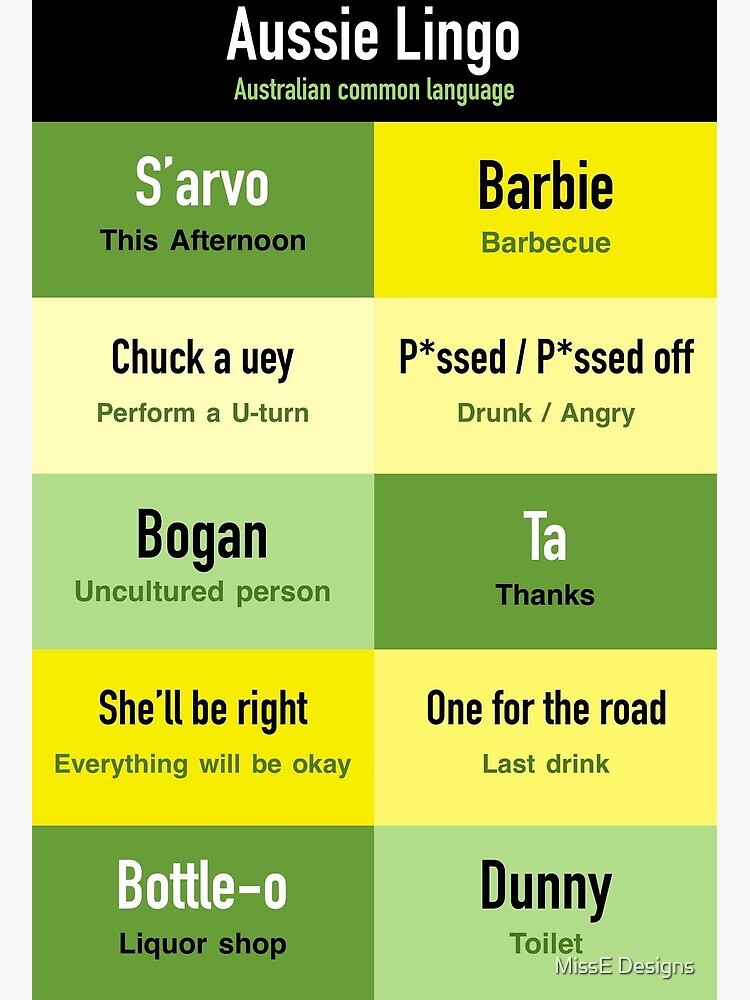
Aussie Lingo" Greeting Card by el46 | Redbubble

Very interesting indeed.
It is fascinating to recognise some of the words that I use myself.
I use…
“uey” – I will do a uey
“barbie” – are we doing a barbie?
“ta” – my niece realised this and she pointed this out to me. I use them often without realising it! Hahaha
“she’ll be right” – never use this personally yet heard this expression a lot.

Then there was the experience of working with migrants and having English tutors thinking it was funny to “teach” some of the slang without letting them know it’s not always appropriate to use certain terms in certain circumstances.
Yes some are funny and are used lightheartedly.

So now to the different states and territories and their slang.

A swim suit for example is known by different names around Australia. The most some common terms are:

  • bathers – the most common term in VictoriaSouth AustraliaWestern AustraliaTasmania and occasionally in other states. From bathing suit
  • boardies – short for board shorts
  • cossie or cozzie – from “swimming costume”; usage of this name is generally restricted to New South Wales
  • speedos – generic term for men’s swimming briefs which originated in Australia, from the brand name (see Speedo). Known colloquially as sluggosbudgie smugglers
  • swimmers – used mainly in New South Wales and sometimes used in Queensland, from “swimming costume”
  • togs – used mainly in Queensland, but also by some people in Western Australia and Victoria, to describe any type of swimwear
  • trunks – now virtually extinct, formerly used by some people in various regions, to describe any type of swimwear
SQ Swim Shop

I probably heard swimmers and swimming togs. I had so much trouble understanding when I first arrived to Australia. I think I also heard boardies before. Very interesting of what people comes up with.

A thong is another term – it’s footwear in Australia. Recently I was reminded of the “double plugger”. I’ll find a pic which will explain better than I can.

A backless sandal, usually made of plastic, the top section of which sits between the big and second toes. Known as jandals in New Zealand English. The name thong was also the original name for this footwear in the U.S. but the name flip flop later came to dominate and the term thong in the U.S. now more commonly refers to G-string style underwear. The undergarment is usually called a g-string (or colloquially, bum floss) in Australia, however, due to U.S. influences in Australia the word thong is now also used.

Cinderella Around the World: Book review of Cindy-Ella: An Aussie  Cinderella by Tom Champion | My Little Bookcase

I use tongs. I now wonder why when I said tongs and people had trouble understanding, because it was a slung! I think I heard flip flop as well.

The list goes on and on. I’ve discovdered in my quest to learn other languages, you usually get taught the “slang/swear words” first from locals. We in Australia are not alone in having a “slang” language. Many and I can only imagine all cultures have their “slang”.

Indeed. I can think of some slang in other languages too. Interestingly, until someone question it, I never thought to explore where it comes from.

I believe that if we are going to teach non-English speaking people or people who are learning the language that we share with them English and what is “slang” and encourage them to understand “slang” before using it.

As I did when learning Japanese. There is a profession language, and language for elders, and everyday language and a language (slang) used between friends. I think that’s correct. Maybe Lily can give more clarity around that one.

Our language is the reflection of ourselves. A language is an exact reflection of the character and growth of its speakers.

Cesar Chavez

Yes you are correct HJ.
There are many folds of appropriate use of language to appropriate person and in appropriate situation etc.
I guess, there are no difference in English too.
Certain words, you just don’t use in public.
Some words are used among younger generation which probably wasn’t acceptable in my era.
I also understand language are made in everyday life.
So, what’s appropriate and what’s not??

Carefully watch your thoughts, for they become your words.
Manage and watch your words, for they will become your actions.
Consider and judge your actions, for they have become your habits.
Acknowledge and watch your habits, for they shall become your values.
Understand and embrace your values, for they become your destiny.

Mahatma Gandhi

Do you use Aussie slang? Is it part of your language? What do you think of it??

Who’s turn to “shout” this time?

I have to be very careful who I am sharing a meal/drink with. Where I am, who I am with and for what prupose.
Depending on who I am with, and the purpose, this concept of “shout” may or may not fit.

Great topic Lily. I enjoyed our conversation and hope we can share our thoughts and experiences here.

I know. I guess, living between cultures, I acknowledge the different perspectives so I do openly ask “May I shout you this meal/drink?” Yet, I am aware with my supervisor, because she will ask for a reason, so I am always prepared with a response to that question. WHY? for what PURPOSE?

Who’s turn is it to “shout”? Where did that come from?
Yes, Lily I hear you. I do have to research this first.

Pin by Dayna Trueman on My Pins | Word of the day, Aussie, Australia capital

In Australia

In John O’Grady‘s They’re a Weird Mob, Nino learns some customs related to shouting.

Your turn.

What is my turn?

Your turn to shout

Why should I shout?

Because I shouted you.

I did not hear you shout at me.

He thought for a while and said, I get it. When you buy a bloke a beer, it’s called a shout, see?

Why is that?

I haven’t a clue, but that’s what it’s called. I shouted for you, now it’s your turn to shout for me.

I was only a little thirsty.

I do not think I wish another drink.

He looked quite stern, In this country, if you want to keep out of trouble, you always return a shout, see?

Is this the custom?

Bloody oath, it’s the custom.

Your turn.

Oh no… I thought it was a common English term “shout” yet it was Australian?
Ok, HJ, you got me curious so I went for a search the word “shout”.
According to Oxford Dictionary it stated the following for the word “shout”.

verb:
1. (of a person) utter a loud cry, typically as an expression of a strong emotion.
2. [informal Australian] treat (someone) to (something, especially a drink).
noun:
1. a loud cry expressing a strong emotion or calling attention.
2. [informal British] one’s turn to buy a round of drinks.

Oxford Dictionary

So the word “shout” has been used in the above contexts then.

It’s an interesting experience depending on the people you are with and in what environment you are in. Yes, if someone buys you a drink, meal, treat then it’s “kinda” taken for granted you return the “favour”.

Yes, very interesting you said that. With my supervisor, we take turns. With my friends, we pay for ourselves.
In the culture that I grow up, we have mutual understanding that senior person will pay for juniors. So, when I go out with my aunt, she paid for the majority of the time. I do a bit of extra to pay her back though. I felt it is out of respect. So, she might buy a meal for us then I will buy a drink for her.

I had a very interesting experience once. I went to buy a snack and I met my aunt there. She saw me was ordering and she subsequently bought my snack too. I was appreciative and said thank you. That was the culture I grow up. I was uncomfortable though.

In my experience, I’ve done this and then in many situations, when I was in a financial situation to do so, I’d invite friends out, pre paying for the experience, whether a meal, going to the movies, or an outing. Others have done this for me and I so love being able to return the favour. It’s a bit like the “pay it forward” movement. It is so much more comfortable being in the company of those who do not expect anything from the others. They pay if they can and don’t if they can’t. Expecting others to buy you something because you bought/paid for them, is not the type of person I want to be around. A conversation would be had and hopefully a new understanding would happen.

This is a very interesting concept. “Who’s turn?” is always a big question in the culture I grow up.
When we had dinner with friends, I saw parents fight for “who’s paying?” at the register. There’s this mutual respect of not offending others. Yes, seniors tend to pay yet you don’t want them to think it is always them who needs to pay.

Let me share another experience with you.
One night my family decided to have a dinner in a resturant. At our arrival, we found a long time friend who we lost contact. My parents quickly shared updates with them and we have ordered our meal. This friend was finishing off their meal. Obviously, this friend had left earlier than us. At the end of the meal, my mother went to pay yet she couldn’t because that friend had paid for our meals too.
This happens often in the culture I grow up. It is the mutual respect of friendship. Yet, growing up in Australia, I felt uncomfortable about this notion of mutual respect.

Then of course there are those who will allow you to pay for things and not return the favour. They either disappear when it’s “their turn” or just don’t see it as necessary. Again, it’s a situation you can choose to repeat or not.

Yes, I know. Who allows you to pay? Are you expecting a return? What if they didn’t?
All these questions will arise and it is up to you to make the balance.
Personally, I don’t like people shouting me or I shout them. For me, to balance my feeling of fairness, I do appreciate if I can pay for myself, or know when to pay back for those who have paid for me.

I’ve discovered from my experience to set it up first. Ask the questions “whose paying for what?”, “it’s my turn”, or “I’d like to treat you?” And if I am on the receiving end, I am extremely grateful and accept graciously. It’s a gift to give to another to allow them to experience giving as well as receiving. I get so much pleasure out of giving, so why not allow others to have that as well??

Yes, I agree with you HJ.
Setting up before hand saves a lot of trouble.

BIRTHDAYS

HJ, what about birthdays?
I think we have discussed this in another post yet this is an interesting event, great for discussion.

This is often a challenging time. Some people are expected to pay for their meal to attend. Some supply the meal and you pay for your drinks. Some supply everything.

Birthday Invitation Wording Ideas | Invitation Sayings

In the culture I grow up, if you are invited to a birthday party, you bring in a present and they will pay for the meals and drinks. In some case, they accept you bring a present that’s equals or around your meal. Depending on the culture, you may have party bag for kids.

With this comes the present giving. Are you expected to give a present if paying for your meal/drinks? These days it’s pretty well “spelt out” in the invitation. I still struggle with that one. If I’m inviting friends to share my birthday with me then I pay for the celebration, however that is. Sometimes it’s drinks and snacks, or a meal with wine, beer and soft drinks. I have not had a celebration where I expected others to pay for their meal/drinks and I certainly haven’t asked for money, or “see the present register” or to donate to a cause close to my heart. For me sharing a special occasion with others is all about the experience and not about the “show” or what I’ll get. It can be a strain on relationships. These days, for me, it’s whatever makes them happy, yet I don’t have to go along with their plans. I still do what I feel comfortable doing. Even if that means not attending. I will still give a gift appropriate to the occasion.

I would struggle with that too. Recently, with myself and my friend circle, we decided to have no presents and agreed to have a meal together at own cost. Very interesting!! It is hard to set the boundaries sometime yet it is a choice.

I have a friend who would pay for everything, even when we went out as a group of friends. I did appreciate his generousity yet it made me feel uncomfortable. One day I said to him “for what purpose are you shouting my meal?” He just said to enjoy the time together as a group of friends. Yet, it is unfair for him to pay all the time. I have told him that “I really appreicate your generousity yet I am able to pay for my own meal.”

Who’s turn is it to “shout”?

Let it be about sharing time with true friends who don’t keep score.

Quotes about Friends and celebration (23 quotes)