

Hi HJ, very interesting topic for the post. I think slang exist in all language. Yet, as I use it without thinking, and learning English as an adult, I hardly able to differentiate slang to proper English.
Yes, the language unique to Australian and also to different States and Territories.
Let’s investigate some of the most common terms and share our experiences and thoughts.
Very excited to find what I use as my everyday language. I might be surprised to see what was “slang”.
I find some of these words funny and others offensive. Yes, it is a very personal thing. I had a relationship with a guy who used the Aussie Slang all the time. Used to drive me mad. Why not just use the “correct word”? That’s me.
I guess not just slang, I learn to ask the meaning of the word that I can’t understand.
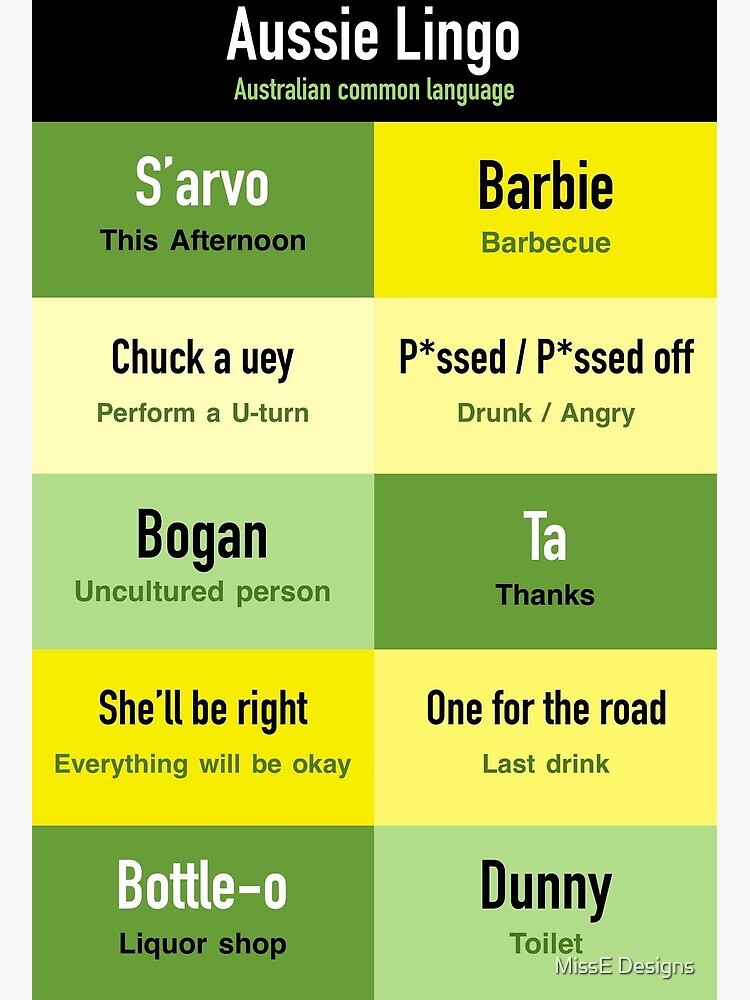
Very interesting indeed.
It is fascinating to recognise some of the words that I use myself.
I use…
“uey” – I will do a uey
“barbie” – are we doing a barbie?
“ta” – my niece realised this and she pointed this out to me. I use them often without realising it! Hahaha
“she’ll be right” – never use this personally yet heard this expression a lot.
Then there was the experience of working with migrants and having English tutors thinking it was funny to “teach” some of the slang without letting them know it’s not always appropriate to use certain terms in certain circumstances.
Yes some are funny and are used lightheartedly.
So now to the different states and territories and their slang.
A swim suit for example is known by different names around Australia. The most some common terms are:
- bathers – the most common term in Victoria, South Australia, Western Australia, Tasmania and occasionally in other states. From bathing suit
- boardies – short for board shorts
- cossie or cozzie – from “swimming costume”; usage of this name is generally restricted to New South Wales
- speedos – generic term for men’s swimming briefs which originated in Australia, from the brand name (see Speedo). Known colloquially as sluggos, budgie smugglers
- swimmers – used mainly in New South Wales and sometimes used in Queensland, from “swimming costume”
- togs – used mainly in Queensland, but also by some people in Western Australia and Victoria, to describe any type of swimwear
- trunks – now virtually extinct, formerly used by some people in various regions, to describe any type of swimwear

I probably heard swimmers and swimming togs. I had so much trouble understanding when I first arrived to Australia. I think I also heard boardies before. Very interesting of what people comes up with.
A thong is another term – it’s footwear in Australia. Recently I was reminded of the “double plugger”. I’ll find a pic which will explain better than I can.

A backless sandal, usually made of plastic, the top section of which sits between the big and second toes. Known as jandals in New Zealand English. The name thong was also the original name for this footwear in the U.S. but the name flip flop later came to dominate and the term thong in the U.S. now more commonly refers to G-string style underwear. The undergarment is usually called a g-string (or colloquially, bum floss) in Australia, however, due to U.S. influences in Australia the word thong is now also used.

I use tongs. I now wonder why when I said tongs and people had trouble understanding, because it was a slung! I think I heard flip flop as well.
The list goes on and on. I’ve discovdered in my quest to learn other languages, you usually get taught the “slang/swear words” first from locals. We in Australia are not alone in having a “slang” language. Many and I can only imagine all cultures have their “slang”.
Indeed. I can think of some slang in other languages too. Interestingly, until someone question it, I never thought to explore where it comes from.
I believe that if we are going to teach non-English speaking people or people who are learning the language that we share with them English and what is “slang” and encourage them to understand “slang” before using it.
As I did when learning Japanese. There is a profession language, and language for elders, and everyday language and a language (slang) used between friends. I think that’s correct. Maybe Lily can give more clarity around that one.
Our language is the reflection of ourselves. A language is an exact reflection of the character and growth of its speakers.
Cesar Chavez
Yes you are correct HJ.
There are many folds of appropriate use of language to appropriate person and in appropriate situation etc.
I guess, there are no difference in English too.
Certain words, you just don’t use in public.
Some words are used among younger generation which probably wasn’t acceptable in my era.
I also understand language are made in everyday life.
So, what’s appropriate and what’s not??
Carefully watch your thoughts, for they become your words.
Mahatma Gandhi
Manage and watch your words, for they will become your actions.
Consider and judge your actions, for they have become your habits.
Acknowledge and watch your habits, for they shall become your values.
Understand and embrace your values, for they become your destiny.
Do you use Aussie slang? Is it part of your language? What do you think of it??


 In Conversation